The Holocaust in the Galician Oil Belt

Kategorie: Uncategorized

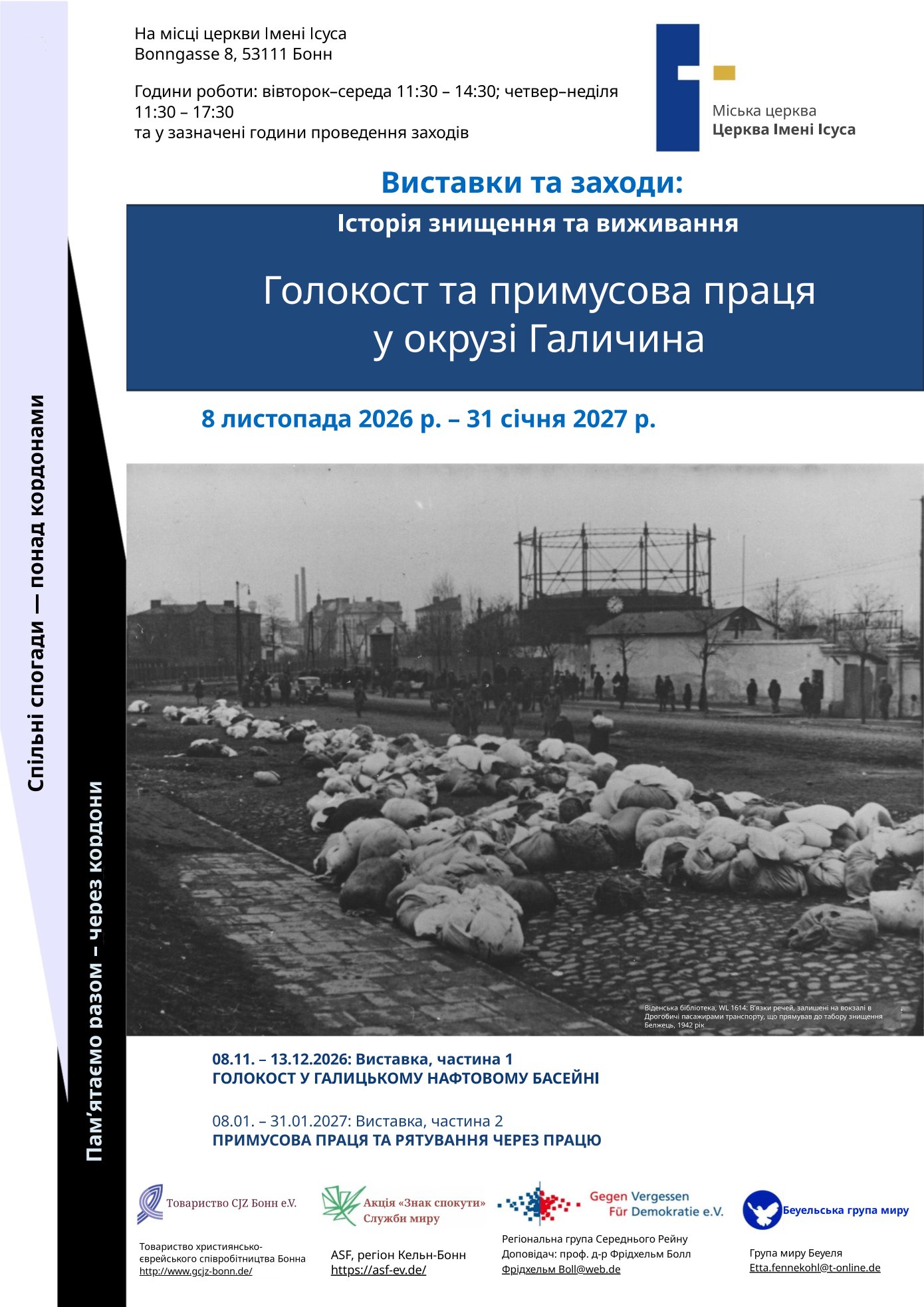
Виставка в Бонні з 8 листопада 2026 року

Попереднє оголошення — через три тижні у Бонні відбудеться:
Виставка та заходи, присвячені Голокосту в Галичині
—————————————————————–
З 8 листопада у бароковому костелі «Імені Ісуса» в центрі Бонна — всього за кілька метрів від Будинку Бетховена — буде відкрито виставку «Голокост і примусова праця в окрузі Галичина».
Історія створення виставки
Виставка базується на роботі міжнародної команди, ініційованій робочою групою організації «Акція знаків спокути та миротворчих служб» (ASF) у співпраці з організацією DBO (організацією тих, хто пережив Голокост, та їхніх нащадків з району Дрогобича-Борислава у Галичині) та фондом «Fundacja Bente Kahan» з Вроцлава (Wroclaw) у Польщі. Ця двомовна виставка з 2015 року була представлена понад двадцять разів у Польщі, Україні, Ізраїлі та Німеччині й неодноразово доповнювалася. Останнє значне доповнення відбулося у співпраці з Документаційним центром примусової праці нацистів у Берліні на тему примусової праці євреїв у Галичині.
Виставка в Бонні
відкриється 8 листопада 2026 року і буде експонуватися у двох частинах до кінця січня 2027 року. Організаторами виставки є товариство «Проти забуття — За демократію» (Gegen Vergessen – Für Demokratie e. V.), «Група миру Бонн-Бойель» (Friedensgruppe Bonn-Beuel), «Акція знаків спокути — Служби миру» (Aktion Sühnezeichen Friedensdienste, ASF) та Церква Імені Ісуса, за підтримки Товариства християнсько-єврейського співробітництва (www.gcjz-bonn.de).
У рамках виставки відбудеться низка заходів; додаткова інформація буде опублікована згодом
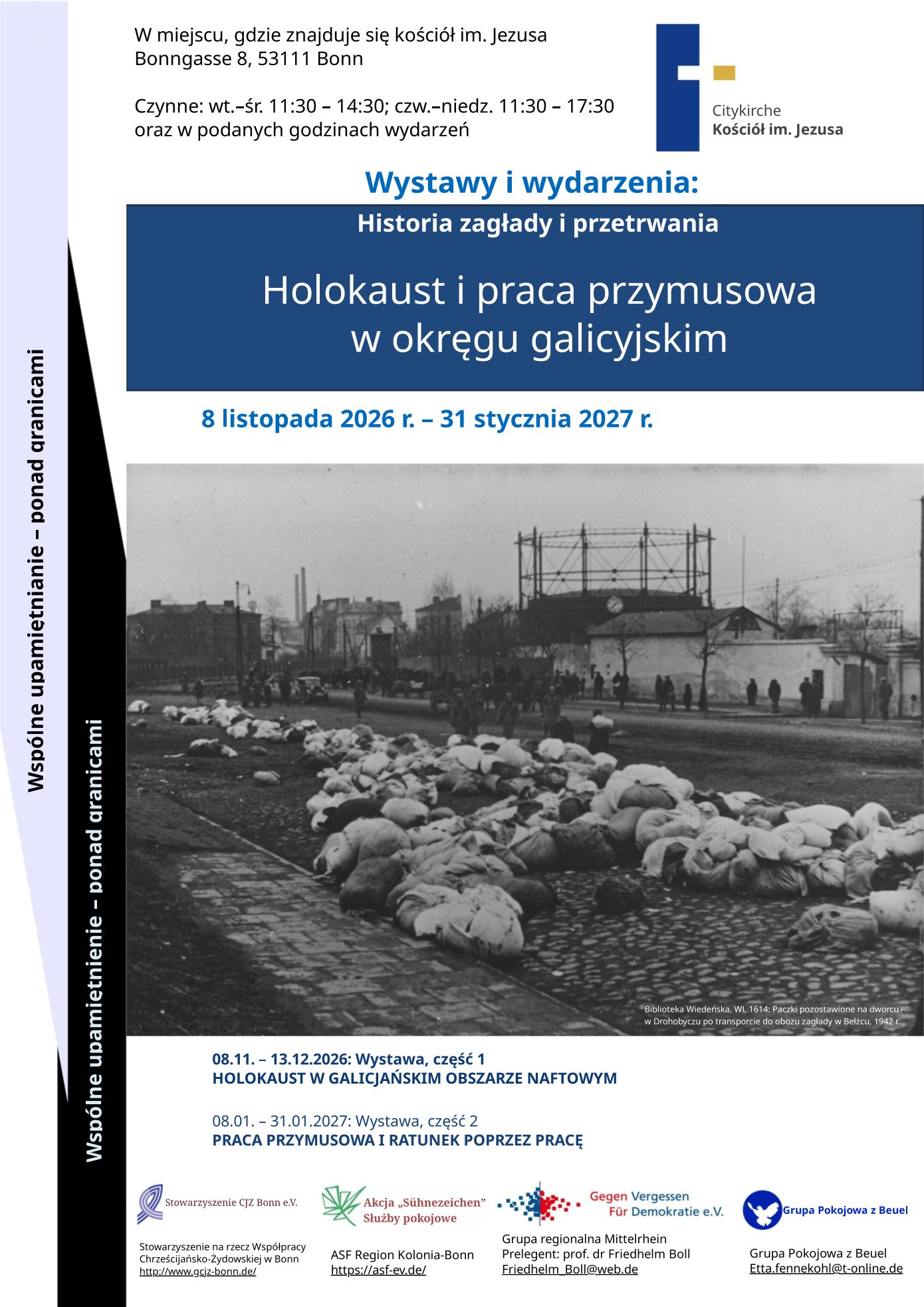
Wystawa w Bonn od 8 listopada 2026 r.

Zapowiedź – za trzy tygodnie w Bonn:
Wystawa i wydarzenia poświęcone Holokaustowi w Galicji
—————————————————————–
Od 8 listopada w barokowym kościele „Namen-Jesu-Kirche” w centrum Bonn – zaledwie kilka metrów od Domu Beethovena – będzie można obejrzeć wystawę „Holokaust i praca przymusowa w dystrykcie Galicji”.
Historia powstania wystawy
Wystawa powstała dzięki pracy międzynarodowego zespołu, zainicjowanej przez grupę roboczą organizacji Aktion Sühnezeichen Friedensdienste (ASF) we współpracy z organizacją DBO (zrzeszającą ocalałych z Holokaustu i ich potomków z okolic Drohobycza i Borysławia w Galicji) oraz Fundacją Bente Kahan z Wrocławia w Polsce. Wystawa, przygotowana w wersji dwujęzycznej, była od 2015 roku prezentowana ponad dwadzieścia razy w Polsce, na Ukrainie, w Izraelu i w Niemczech oraz wielokrotnie rozbudowywana. Ostatnie duże rozszerzenie miało miejsce we współpracy z Centrum Dokumentacji Pracy Przymusowej w Berlinie i dotyczyło tematu pracy przymusowej Żydów w Galicji.
Wystawa w Bonn
zostanie otwarta 8 listopada 2026 r. i będzie prezentowana w dwóch częściach do końca stycznia 2027 r. Organizatorami wystawy są stowarzyszenie „Gegen Vergessen – Für Demokratie e. V.”, grupa pokojowa Bonn-Beuel, organizacja „Aktion Sühnezeichen Friedensdienste” (ASF) oraz kościół im. Jezusa, przy wsparciu Towarzystwa Współpracy Chrześcijańsko-Żydowskiej (www.gcjz-bonn.de).
W ramach wystawy odbędzie się szereg wydarzeń; dalsze informacje zostaną podane wkrótce

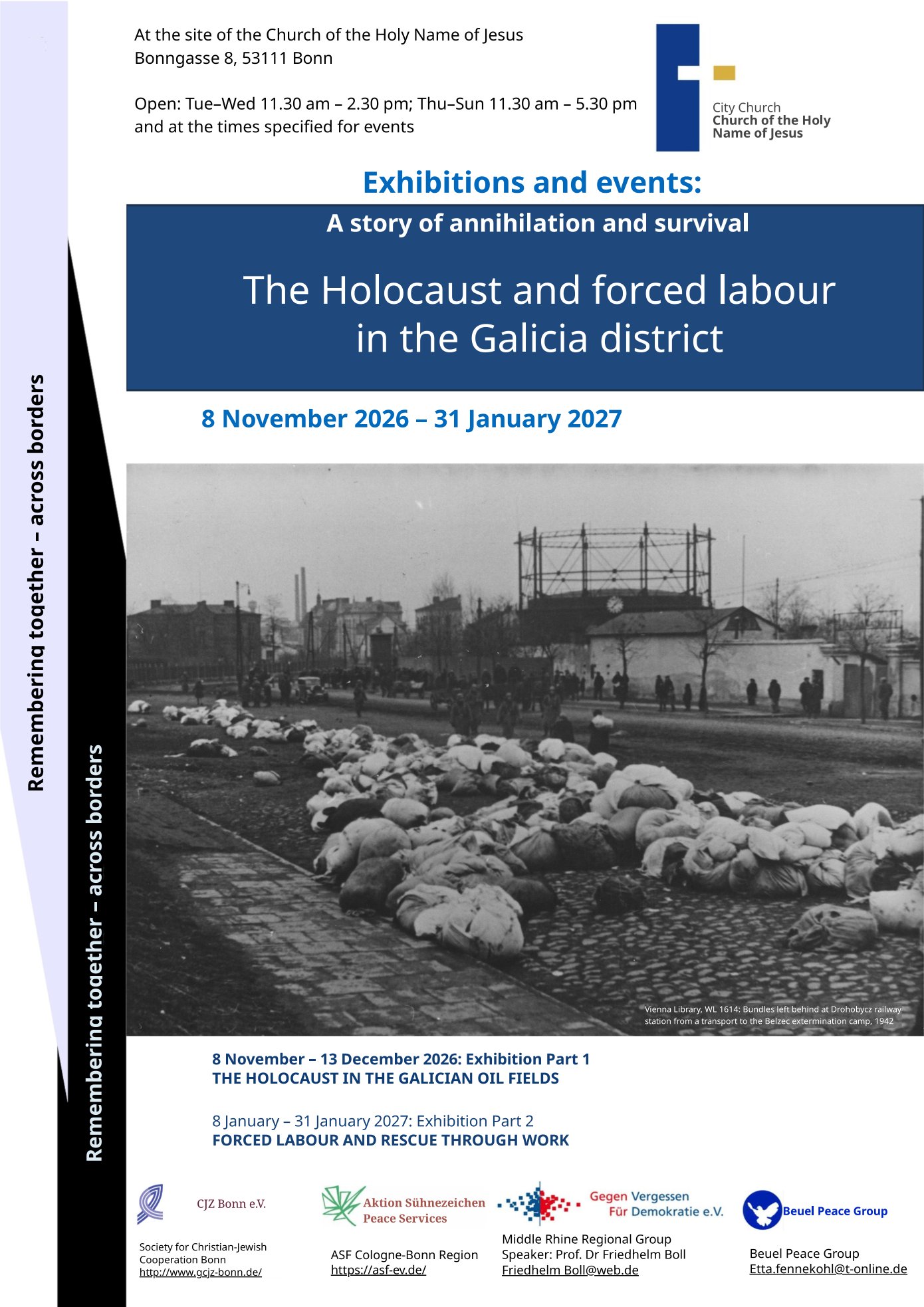
Exhibition in Bonn from 8 November 2026

Advance notice – in three weeks’ time, it’s all happening in Bonn:
Exhibition and events on the Holocaust in Galicia
—————————————————————–
From 8 November, the exhibition ‘The Holocaust and Forced Labour in the District of Galicia’ will be on display at the Baroque ‘Church of the Holy Name of Jesus’ in Bonn city centre – just a few metres from the Beethoven House.
Background to the exhibition
The exhibition is based on the work of an international team, initiated by a working group from Aktion Sühnezeichen Friedensdienste (ASF), in cooperation with the organisation DBO (the organisation of Holocaust survivors and their descendants from the Drohobych-Boryslaw region in Galicia) and the Fundacja Bente Kahan Foundation in Wrocław, Poland. The bilingual exhibition has been shown more than twenty times since 2015 in Poland, Ukraine, Israel and Germany, and has been expanded on several occasions. The most recent major expansion took place in collaboration with the Documentation Centre for Nazi Forced Labour in Berlin, focusing on the topic of forced labour of Jews in Galicia.
The exhibition in Bonn
will open on 8 November 2026 and be shown in two parts until the end of January 2027. The exhibition is organised by the association ‘Gegen Vergessen – Für Demokratie e. V.’, the Bonn-Beuel Peace Group, Aktion Sühnezeichen Friedensdienste (ASF) and the Church of the Holy Name of Jesus, with the support of the Society for Christian-Jewish Cooperation (www.gcjz-bonn.de).
Several events will take place as part of the exhibition; further information will follow

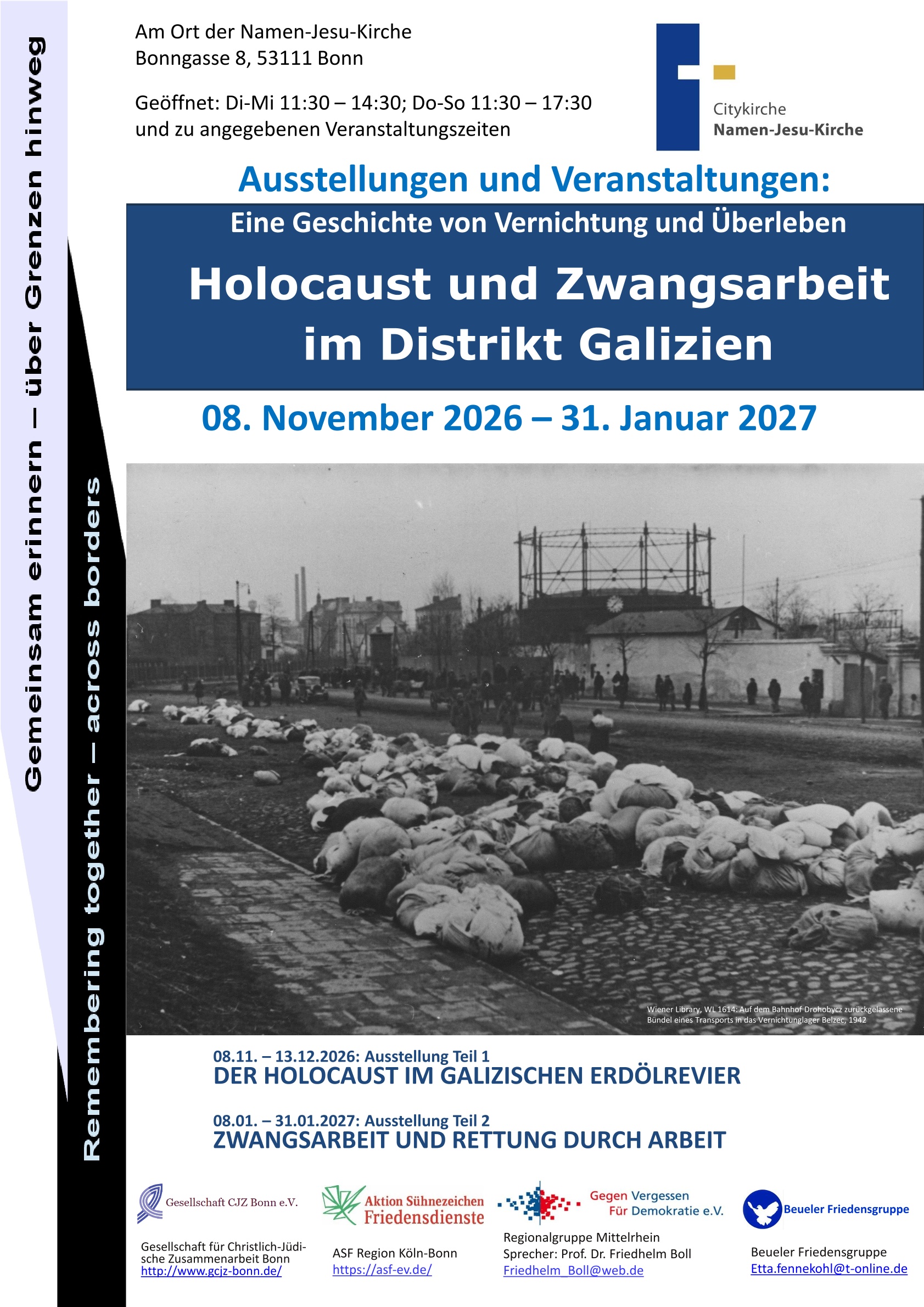
Ausstellung in Bonn ab 8. November 2026

Vorankündigung – in drei Wochen ist es in Bonn so weit:
Ausstellung und Veranstaltungen zum Holocaust in Galizien
—————————————————————–
Ab dem 8. November wird die Ausstellung „Holocaust und Zwangsarbeit im Distrikt Galizien“ in der barocken „Namen-Jesu-Kirche“ in der Bonner Innenstadt gezeigt – nur wenige Meter vom Beethoven-Haus entfernt.
Vorgeschichte der Ausstellung
Die Ausstellung basiert auf der Arbeit eines internationalen Teams, initiiert von einer Arbeitsgruppe der Aktion Sühnezeichen Friedensdienste (ASF), in Kooperation mit der Organisation DBO (der Überlebenden-Organisation des Holocaust und ihrer Nachkommen aus dem Gebiet von Drohobycz Boryslaw in Galizien) und der Stiftung Fundacja Bente Kahan aus Breslau / Wroclaw in Polen. Die jeweils zweisprachige Ausstellung wurde seit 2015 in Polen, der Ukraine, Israel und Deutschland mehr als zwanzigmal gezeigt und mehrfach erweitert. Die letzte große Erweiterung erfolgte in Zusammenarbeit mit dem Dokumentationszentrum NS-Zwangsarbeit in Berlin zum Thema Zwangsarbeit von Juden in Galizien.
Die Ausstellung in Bonn
wird am 8.11.2026 eröffnet und in zwei Teilen bis Ende Januar 2027 gezeigt. Träger der Ausstellung sind der Verein Gegen Vergessen – Für Demokratie e. V., die Friedensgruppe Bonn-Beuel, die Aktion Sühnezeichen Friedensdienste (ASF) und die Namen-Jesu-Kirche, unterstützt von der Gesellschaft für Christlich-Jüdische Zusammenarbeit (www.gcjz-bonn.de ).
Mehrere Veranstaltungen finden im Rahmen der Ausstellung statt; weitere Informationen folgen

Spenden für ukrainische Binnenflüchtlinge

Spenden für die Versorgung von Binnenflüchtlingen in der Bukowina können Sie direkt unter der Bankverbindung des IKGS:
DE23 7015 0000 0907 2714 07
SSKMDEMMXXX
Münchner Stadtsparkasse
Das Zentrum Gedankendach an der Jurij-Fedkowitsch-Universität Czernowitz ist Mitglied im IKGS (Institut für deutsche Kultur und Geschichte Südosteuropas an der Ludwigs-Maximilians-Universität München). Das Zentrum Gedankendach wird sich mit seinem Team und seinem Netzwerk vor Ort in der Region Czernowitz um die Verwendung der Spenden kümmern.
Czernowitz ist 30 km von der rumänischen Grenze entfernt: viele Binnenflüchtlinge kommen hierher, für kurze oder längere Zeit. Es müssen Unterkünfte besorgt und Verpflegung und soziale Betreuung gesichert werden. Das Zentrum Gedankendach ist ein absolut zuverlässiger Partner. Helfen Sie, die Not der Binnenflüchtlinge zu lindern!

Porównanie rang Wehrmachtu, SS, policji

Kiedy czyta się stopnie oficerów SS czy policjantów, zwykle niewiele nam to mówi. SS było jednak silnie zorientowane na hierarchię wojskową Wehrmachtu. Oficerowie Wehrmachtu i policji, zwłaszcza wyżsi, byli prawie wszyscy członkami SS: na każdym etapie kariery, po krótkim czasie, ich stopnie w SS były zrównane z ich stopniami w wojsku lub policji.
Czytaj więcej >  Weiterlesen

Comparing the ranks of the Wehrmacht, SS and police

When you read about the ranks of SS officers or policemen, you usually have little idea of them. Yet the SS was strongly oriented towards the military hierarchy of the Wehrmacht. Officers of the Wehrmacht and police, especially the higher officers, were almost all also members of the SS: at each step of their career, after a short time their ranks in the SS were aligned with their rank in the military or police.
read more > 
Weiterlesen

Vergleich der Dienstränge von Wehrmacht, SS, Polizei

Wenn man Dienstränge von SS-Offizieren oder Polizisten liest, kann man sich meist wenig darunter vorstellen. Dabei orientierte sich die SS selbst stark an der militärischen Hierarchie der Wehrmacht. Offiziere der Wehrmacht und Polizei, insbesondere die höheren Offiziere, waren fast alle auch Mitglieder der SS: bei jedem Karriereschritt wurden nach kurzer Zeit ihre Dienstgrade bei der SS angeglichen an ihren Rang bei Militär oder Polizei.
Weiterlesen

Under construction – Webseite im Aufbau

This website is new and under construction: it will be filled with content. The structure of the website is also not yet complete and stable. It is still published, so that friends can use their comments, criticism and suggestions to help shape the resulting website.

Diese Webseite ist neu und befindet sich noch im Aufbau: sie wird nach und nach mit Inhalt gefüllt werden. Die Struktur der Webseite ist auch noch nicht vollständig und stabil. Sie wird trotzdem veröffentlicht, damit Freunde mit ihren Kommentaren, Kritiken und Vorschlägen  die entstehende Webseite mitgestalten können.